Like many other disciplines, the landscape of medical imaging technology is also shifting from traditional to contemporary models and methods. Today, radiography and imaging technology are more than taking a picture or pressing a button on the equipment. What the medical centres of Karachi, specialised cancer hospitals in Lahore and advanced diagnostic labs in Islamabad require is included in this article. In a nutshell, you will need a comprehensive degree and an upskill practically to land and win as a radiographer in a highly competitive world.
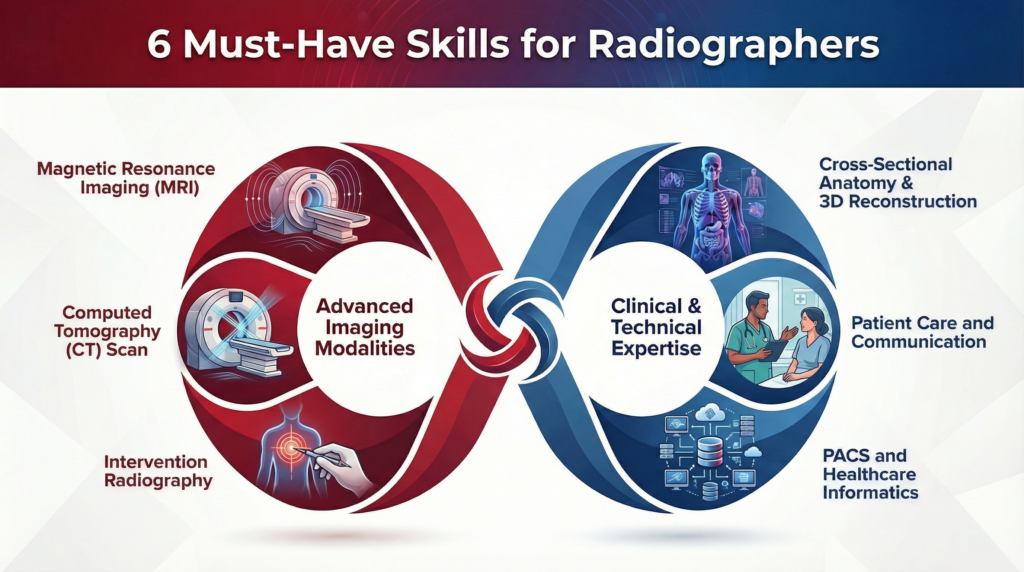
- Magnetic Resonance Imaging (MRI)
- Computed Tomography (CT) Scan
- Cross-Sectional Anatomy & 3D Reconstruction
- Patient Care and Communication
- PACS and Healthcare Informatics
- Intervention Radiography
Magnetic Resonance Imaging (MRI)
Pakistan is witnessing a rise in neurological disorders, Cerebrovascular, and infection-related diseases. Therefore, magnetic resonance imaging (MRI) machines are needed across hospitals and health care centres. MRI machines are helpful in the identification, monitoring, and evaluation of diverse medical conditions. Multiple Sclerosis, Brain Tumour and Cysts, Stroke, Traumatic Brain Injury, Epilepsy, spinal cord disorders, and neurodegenerative diseases are a few to name.
In 2026, professional radiographers will know how to perform complex scans, ensuring patient safety during MRI procedures, and produce high-quality images to easily diagnose health conditions.
Computed Tomography (CT) Scan
The computed tomography is ever evolving. In 2026 and years beyond, professional radiographers need to be proficient in advanced CT technologies and practices. The techniques, such as cardiac CT, CT angiography, and patient management while fulfilling the protocols during low-dose scans.
The expertise a professional radiographer should have is to produce accurate and high- quality images quickly. Moreover, contrast management and machine troubleshooting are also among the demanded skills in 2026.
Cross-Sectional Anatomy & 3D Reconstruction
In image technology, cross-sectional anatomy is an imaging technique to acquire detailed 2D slices of internal body structures. CT scans, MRI reports and specialised ultrasounds are the primary tools to perform the cross-sectional anatomy. These techniques allow 3D representations of the body for evaluation purposes.
Patient Care and Communication
Technical proficiency is undoubtedly a prerequisite to being a professional radiographer in Pakistan and anywhere across the world. However, this is not a complete list of skills you need to succeed. In addition, soft skills and certain personality traits are essential to attain success in the field of radiography and imaging technology.
Patient positioning is one of the crucial elements in imaging technology. Patient support and accurate patient positioning with the least amount of discomfort are the core elements of effective patient management.
Furthermore, patient care is a primary goal of healthcare. It is also essential in radiography. Therefore, reducing patients’ anxiety improves diagnostic accuracy. With all this, patient consent is essential to take; the radiographers also need to be rich and easy in diverse communication. This skill will help them deal with a wide range of patients effectively.
PACS and Healthcare Infographics
Experts in imaging technology should have expertise in picture archiving and communications. This skill is commonly known as PACS. The health information technology is essential for managing digital images, data security and efficient workflow.
A professional radiographer must know the DICOM standards and electronic medical records integration. This skillset is essential to handle the digital data sources while maintaining patient privacy and sorting data to access when needed.
Intervention Radiography
With all these skills, a professional radiographer should also know intervention radiography. These skills are in high demand because of the increase in the usage of MRI and CT scans. The radiographer should know proficiently about angiograms, biopsies, and vascular interventions. With sterile techniques and sound technical knowledge, 2026 demands these skills.
With all these skills, radiographers need a bunch of soft skills. Communication, customer service, operations, and management are some of the extra skills which are good to have as a radiographer in 2026 across the healthcare settings.
BS Radiography and Imaging Technology
To become a radiographer in Pakistan, you need a four-year degree in Radiography and Imaging Technology. This degree programme equips students with the knowledge and skills necessary to perform diagnostics and procedures, to manage advanced equipment and to acquire high-quality results while ensuring high-end patient care.
This healthcare degree and profession are highly demanded and valued across the globe. If you have a sound foundation of knowledge and practical experience through hands-on training, you can enjoy a diverse and wide range of opportunities across the globe. The scope ofthe BS in Radiography and Imaging Technology is not limited to location. However, upgrades and scaling are required for better opportunities as per the target location of work.
Lahore-UBAS offers an opportunity to enrol in BS in Radiography and Imaging Technology in Spring 2026. We offer a rich, experienced, and learned faculty of allied health sciences to offer BS Radiography for students interested in becoming professional radiographers in the coming years.
Apply Online in Spring 2026
Applying to Lahore-UBAS isa very easy and self-explanatory process. You can fill out the admission form at the admission portal. For complete guidance, you can visit the blog.
Conclusion
Radiographer is in demand and highly skilled professional of allied health sciences globally. To help in identification, effective diagnosis with accurate result production, and the safety of digital resources are some of the most demanded proficiencies in 2026. Lahore-UBAS offers a carefully curated and industry- relevant academic programme for the interested ones.